





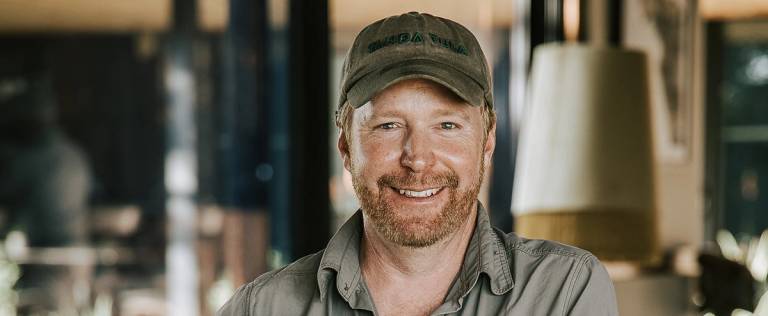
Head guide Chad Cocking has spent almost twenty years in the Timbavati, nine of them at Tanda Tula.
He has never tired of it, and knows the day he’ll stop.
The day I wake up and don’t want to talk about another impala rutting season is the day I hang up my guiding shoes. I’m nowhere close.

A first game drive at nine months old
Chad grew up in Johannesburg, the youngest of three boys. Two or three times a year, the family drove to Ingwelala, a small reserve bordering the Timbavati, where his father had the use of a bungalow. There’s a photograph of Chad on his first game drive at nine months old.
“My earliest memories as a human are of game drives,” he says. “I used to dream about winning the lottery and buying a game reserve, just so I could live in the bush. I never won the lottery, so I needed another plan.”
His parents were new to it too. On their first trip to the Kruger, they saw a wild dog, took it for a hyena and went home disappointed with the day.
The degree that lost out to a camera
After school, Chad did a year-long guiding course, mostly to better understand what he was seeing on holiday. Then he did the sensible thing and studied environmental management for four years at what is now the University of Johannesburg.
Digital cameras were becoming affordable, and wildlife photography became an obsession. “I realised I was spending more time looking at wildlife photography sites than at scientific journals,” he says. “I needed to get it out of my system.” The plan was simple: a year as a guide before his master’s, in the bush every day with a camera in his hand.
In his mind it was a done deal. His father asked the practical question: with no experience, where exactly would he find a job? “I hadn’t thought of that.” Motswari, in the Timbavati, was next door to Ingwelala, and to Chad it had always seemed to be where the animals were hiding. His father made a few calls, and at the start of 2007 Chad was taken on as a student. Within months he was guiding. The one year became eleven.
Why the Timbavati
When he grew restless, Chad went to look at some of the best-known lodges in the Lowveld. “All of them were wonderful, but they always missed something. Whenever I got back into the Timbavati and went on my first drive, I’d think: I never felt this there.”
What he’d missed was the space, and the quiet. “You can easily do a game drive here without seeing anyone. That time alone with my guests became a very important part of why I love this area.”
By then Chad had known Dale Jackson for years. Dale, one of Tanda Tula’s co-owners, was a friend of Motswari’s managers, and the two had met socially. Every so often, a message would arrive from him: if Chad was ever ready for a change, he should say so. For a long time he wasn’t.
Then his friends at Motswari moved on, and it was time. A former intern mentioned she was on her way to Tanda Tula. “If you see Dale,” Chad told her, “tell him I’m ready.”
Within two hours, an email landed in his inbox. Tanda Tula was looking for a guide, Dale wrote, and if Chad had any CVs he wasn’t using, he was welcome to pass them on. Chad attached his own.
Dale had his reasons for asking.
What I’ve always admired about Chad is his passion for the bush. His photography is one thing, but he’s one of the most extraordinary guides. His talent goes far beyond the camera. He can read the finer details in his environment, and he can read the finer details in his guests. Whoever they are, he works out the experience they came for and delivers it.
Chad joined in December 2017, when Tanda Tula was still a tented camp. “I haven’t regretted it for a day.”
How Chad guides
Before the first drive, Chad wants to know how many times you have been on safari, where you’ve been and where you’re going next. Guests arriving from the East African migration have seen more plains game than the Timbavati will ever show them, so he looks for what they haven’t had: a leopard or a pride of lions with no other vehicle in sight. If Tanda Tula is your first safari, the drive slows right down. “I’ll stop for anything and everything: the first herd of impala, the first zebra, the first giraffe. It’s absolute bliss. There’s nothing to compare us to, and there’s time to enjoy all of it.”
The novelty of a first game drive has never worn thin for him. “Seeing people’s reactions when they see a giraffe for the first time never gets old. That life-changing reaction fuels me.” After twenty years, his own delight in the smallest things is still obvious, and it’s infectious.
Tanda Tula’s guides work as a team. They’re in touch throughout a drive and share what they find, but nobody sits on anybody else’s tail. Each guide shapes the drive around their own guests. “It’s not a checklist. Yes, we want you to see as much as you can, but we don’t need to race from sighting to sighting. I have no qualms if Tristan’s guests see a leopard and mine don’t. Over a stay, it always evens out.”
That certainty runs through the whole guiding team. Each guest’s safari is shaped around them, and nobody leaves feeling they missed something.
The moments between the photographs
Chad’s photographs fill our monthly wildlife reviews, and his guide to getting the best out of your iPhone on safari is one of the most-read pieces on this site. He’ll happily show you how to photograph the stars on your phone. He’ll also often park somewhere that seems to have no view at all. He reads where an animal is heading and, with a photographer’s eye for position and light, puts the vehicle where it needs to be before the animal gets there. “The guests say, we can’t see anything. I say, give it two minutes.” Then the elephant walks out of the thicket into open ground and good light.
Guests soon learn to trust him, even when they can’t see what he’s up to. He’s modest about it. “The good thing is they only remember the predictions that came true.”
Dale finds him maddening on this front. “We’ll be at the same sighting. Chad picks up his camera, takes a couple of shots, puts it down and carries on with his guests. I spend far longer at it, go home and edit for hours, and you’d still think we’d been at two different sightings. It’s his gift.”
The kitchen has its own complaint: Chad’s vehicle is usually the last one back. “The chef has been known to want to pull his hair out,” Dale says. But his guests come back happy, so nobody begrudges him.
For all that, Chad would put the camera down before he’d miss the moment. “I’d much rather watch lions after dark, when you can’t take a photograph but they’re awake and doing things, than be there at a quarter to six with perfect light while they sleep.”
The experience comes first, and for him it only counts when it’s shared. He learnt that during lockdown, with the reserve to himself. “It was nice to sit as long as I wanted with lion cubs, but it felt a little hollow with nobody to share it with.”
Lions, leopards and a change of heart about elephants
Ask for a favourite, and he’ll say lions, for the politics between the prides as much as the animals. Leopards come with a caveat: “A leopard that obliges is wonderful. Most leopards don’t.”
Elephants are the surprise. As a child at Ingwelala, he was terrified of them. “If one came within fifty metres of the car, I’d be shouting at my dad to go.” Now he switches off the engine and waits. “The closer an elephant comes, the better, as long as you’re reading it and giving it space. To be that near this animal if it is comfortable with you is a feeling I can’t describe.”
Chad and Jack
On the tracker’s seat is Jack Ngomane, one of South Africa’s few master trackers, with 35 years of reading this ground. The two barely speak on drive. A hand movement or a glance is enough.
Chad’s favourite story about Jack comes from one of the quietest drives he’s ever had. The guests wanted one thing, a leopard. Not far from camp, Jack found tracks going into a block of thick bush. They drove right round it and found none coming out. “Drop me off,” Jack said. “Don’t go far.”
Chad circled the block while Jack went in on foot. Jack found her and called the vehicle in, but by the time it had moved through the bush, she had gone. So he climbed down and tracked her again. And then a third time, before the guests finally saw her.
They saw one steenbok and one leopard on that drive. “It was an average leopard sighting,” Chad says, “and I’ll never forget it.” The tracking was the sighting: a master at work, sure that the tracks were fresh and that he would find her, and a vehicle full of guests trusting him to.
Sometimes it isn’t tracks at all. Recently, with guests who had come from East Africa without seeing cheetahs, Chad had searched the usual area, was ready to give up, and turn for a pride of lions on a fresh kill. Jack pointed the other way. Chad told his guests it was Jack’s call, and that they might see nothing at all for it. Some forty minutes later they rounded a corner onto three cheetahs. “What made him say, on that day, go and look there? I don’t know.”
If Jack tells me to move because a buffalo looks grumpy, I don’t ask why. I move.
Bush, then beach
This year Chad got engaged to Monique on a beach in Mozambique, an hour-and-a-half flight from camp. So when guests tell him they’re flying on to Mauritius or the Seychelles after their safari, he has a suggestion closer to home, and he makes it with some authority. It’s one of the journeys our guests ask about most: a safari and beach honeymoon.
Why guests come back, and why Chad stays
Some of Chad’s guests have driven with him for years. With Susan, who has stayed with us sixteen times, he recently sat in the dark beside a leopard whose cub is so wary of vehicles that it has hardly ever been seen. After twenty minutes of silence, the cub walked out to its mother, and under an infrared light, which doesn’t disturb the animals, they sat quietly and watched the two together. He can’t put that one into words.
Ask him why guests like Susan return, though, and he doesn’t mention leopards. “They come back because of the people.”
It’s why he has stayed, too. Everyone here is encouraged to be themselves, and that mix of people and skills is what makes Tanda Tula what it is. “We’re happy people,” he says. “And the more I do this, the more I love it.”
Dale puts it simply.
He’s our head guide, and he does an exceptional job. He understands the Timbavati, and he understands people, and he’s such a team player that the others naturally look up to him. That’s what makes a good leader.
Luring him further up the ladder is another matter. Dale has tried, gently, for years. “But take him out of the bush, and you unplug him from his source. That’s where he gets his energy.”